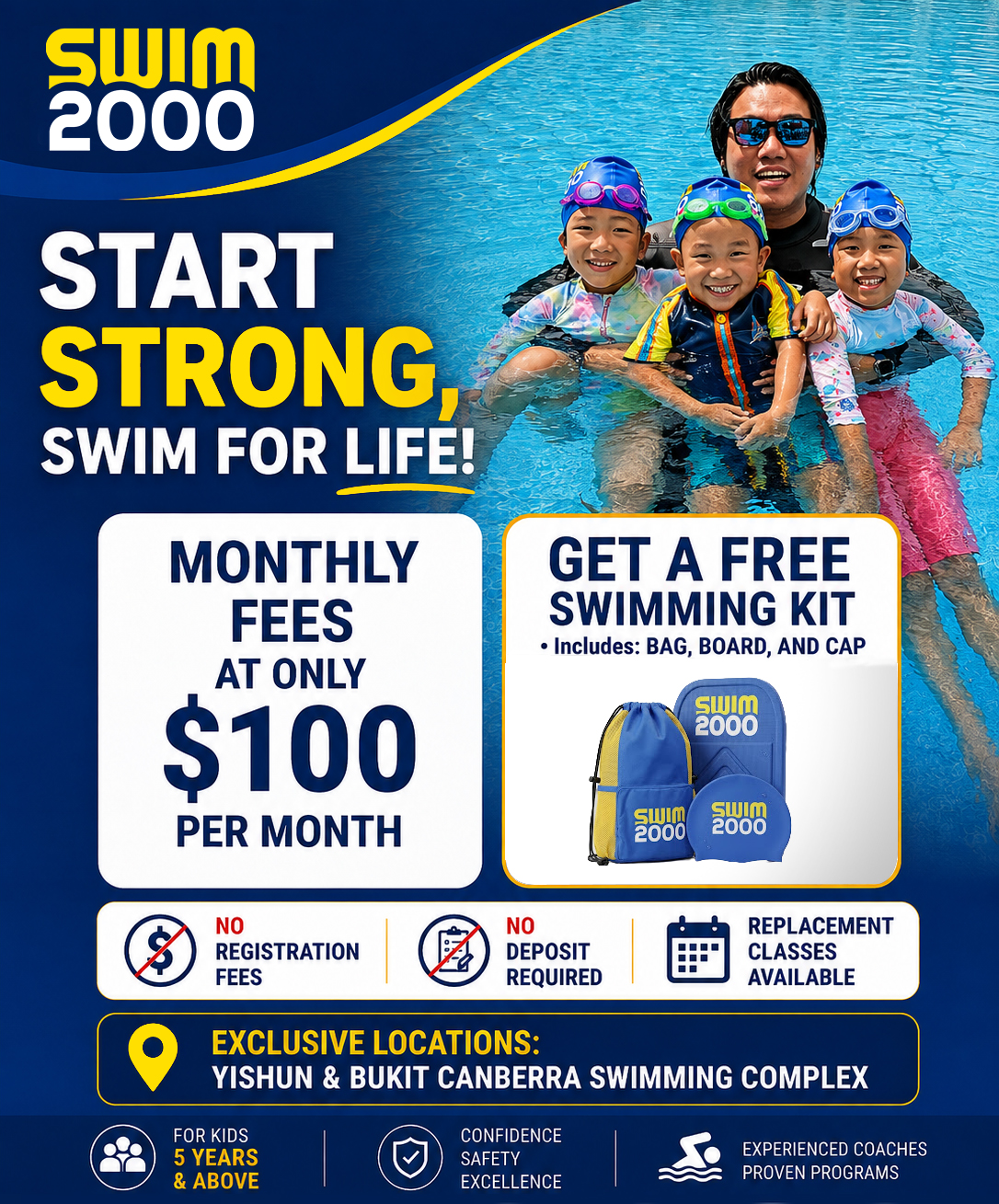
Swimming Lessons for Teenagers in Singapore: What Parents Should Know

Swimming lessons for teenagers are not the same as lessons for young children. A teenager may be starting from zero, returning after years away from the pool, or able to swim but still lacking efficient technique. The right lesson should match that starting point rather than treating age as the main measure of ability.
For parents in Singapore, the practical question is usually not whether a teenager is “too old” to learn. It is what kind of coaching will help them progress without making them feel out of place.
Why teenagers may start swimming later
There is no single reason a teenager reaches secondary-school age without strong swimming skills. Some learned basic water skills when younger but stopped before developing reliable strokes. Others may have had limited practice, changed activities, or simply never became comfortable in deeper water.
A late start does not mean the learning process has failed. It means the coach needs an accurate starting point.
For a complete beginner, early lessons may focus on breathing, balance, floating, body position and moving through the water with control. A teenager who can already swim a length may instead need work on freestyle breathing, breaststroke timing or overall efficiency.
This distinction matters because “teenager swimming lessons” can describe very different needs.
Start with ability, not age
A useful first step is to assess what the teenager can actually do in the water.
Questions include:
- Are they comfortable putting their face in the water?
- Can they exhale underwater without holding their breath?
- Can they float and regain a standing position calmly?
- Can they move through the water without relying on the pool wall?
- Can they swim a recognisable stroke?
- Can they maintain technique for more than a short distance?
- Do they become anxious when they cannot touch the bottom?
These observations are more useful than assuming a 13-, 15- or 17-year-old belongs at a particular level.
A teenager who is physically strong may still be a beginner in water. Conversely, a teenager with years of casual swimming may need stroke correction rather than beginner instruction.
The main challenge may be confidence, not fitness
Teenagers are usually more aware of how they compare with other people than younger children are. A beginner may feel uncomfortable joining a class where much younger swimmers appear more capable.
That can affect learning even when the teenager has enough physical ability to progress quickly.
Parents should therefore distinguish between water confidence and social confidence. A teenager may be perfectly willing to learn but dislike feeling watched, being placed with small children, or repeatedly failing a skill in front of others.
The coaching environment matters. Instructions should be age-appropriate, direct and technically useful. Progress should be measured against the swimmer’s own starting point.
For a teenager who is nervous in the water itself, the priority is different. The lesson should build control before speed or distance. Our guide to children’s swimming lessons in Singapore also explains why foundational confidence matters before more advanced swimming skills.
What should a teenage beginner learn first?
A beginner needs foundations that make later stroke learning easier.
Breathing control
Many inexperienced swimmers instinctively hold their breath underwater and then rush both the exhale and inhale when the face comes up. Learning to exhale in the water makes breathing more controlled.
Balance and body position
Swimming becomes much harder when the legs sink and the swimmer fights to keep the head high. Floating and streamlined body-position work help a beginner understand how the water supports the body.
Propulsion
Kicking and basic arm actions should create controlled forward movement. The goal is not maximum effort. It is learning which movements actually move the body efficiently.
Recovery and stopping
A swimmer should also know how to stop, regain a stable position and reach a safe point without panic. Being able to swim forward is only one part of water competence.
Once these foundations are stable, the coach can develop recognisable strokes and gradually increase distance.
What if the teenager can already swim?
Being able to cross a pool does not necessarily mean formal lessons have nothing to offer.
A self-taught or recreational swimmer may use a lot of energy for relatively little speed. Common examples include lifting the head during freestyle breathing, losing body alignment, kicking inefficiently, or having poor timing between the arms and legs in breaststroke.
In this situation, repeatedly swimming more lengths may reinforce the existing movement pattern. Technical feedback becomes more important.
A stroke correction clinic may be more suitable when the swimmer already has basic water confidence and can perform the stroke but needs specific corrections.
The key distinction is simple: beginners need to build skills; developing swimmers may need to refine them.
Group or private swimming lessons for teenagers?
Neither format is automatically better.
Group lessons can work well when the teenager is comfortable learning with others of a similar ability. They also provide repeated practice while the coach works with different swimmers.
Private lessons provide more individual attention and can be useful when the swimmer has a specific technical problem, feels uncomfortable in a mixed-age group, or needs the lesson to move at a very particular pace.
The decision should depend on the swimmer’s ability, personality and objective rather than the assumption that older learners always need private coaching.
Parents should also ask how swimmers are grouped. Ability matching can matter more than exact age matching.
How quickly can a teenager learn to swim?
There is no reliable universal number of lessons.
Progress depends on the starting point, water confidence, coordination, lesson frequency, practice and the standard being used to define “can swim.”
One teenager may already be comfortable underwater and learn basic stroke mechanics quickly. Another may need more time simply to become relaxed enough to float and breathe consistently.
A more useful approach is to track specific milestones:
- improved comfort in deeper water;
- controlled exhalation;
- stable floating and body position;
- independent movement;
- recognisable stroke mechanics;
- increasing distance without technique collapsing.
These milestones show whether learning is progressing even before the swimmer reaches a particular distance or stroke standard.
Should teenagers follow SwimSafer?
SwimSafer is relevant to water-safety and swimming development in Singapore, but parents should not assume that every teenage learner has exactly the same objective.
Some teenagers may be learning primarily because they want basic water competence. Others may want structured progression, stronger strokes, fitness, or preparation for a particular activity.
The first question should therefore be the swimmer’s current ability and goal. A coach can then determine whether a structured programme, general lessons or technique-focused coaching is the better fit.
How parents can support a teenage learner
Parents can help most by treating swimming as a skill to develop rather than a childhood milestone that was missed.
Avoid comparisons with younger siblings, classmates or children who started swimming years earlier. Those comparisons provide little information about the teenager’s own progress.
Instead, ask concrete questions: Is breathing easier than last month? Can they swim farther while staying relaxed? Is freestyle becoming smoother? Can they recover calmly if a stroke breaks down?
Teenagers can also benefit from understanding the reason behind corrections. A technical explanation such as why head position affects body alignment is often more useful than simply telling an older learner to “try harder.”
For questions about lesson suitability, SWIM2000’s FAQ provides additional information about learning and programmes.
Choosing swimming lessons for a teenager in Singapore
Look beyond labels such as “kids class” or “beginner class.” The useful questions are about how the lesson actually operates.
Ask how the coach assesses a new swimmer, how ability groups are formed, what happens if the teenager progresses faster or slower than the group, and whether the programme can accommodate someone who has a mixture of strengths and weaknesses.
Location also affects consistency. Families in the north can consider swimming lessons in Yishun or swimming lessons at Bukit Canberra if those locations make regular attendance practical.
Consistency matters because swimming is a motor skill. Long gaps between lessons can make it harder to retain newly learned timing and movement patterns.
Frequently Asked Questions
Is 13, 15 or 17 too late to learn swimming?
No. Age alone does not determine whether someone can begin learning. The starting programme should reflect the teenager’s water confidence, current skills and goals.
Can a teenager learn swimming from zero?
Yes. A complete beginner can start with breathing control, floating, body position, basic propulsion and safe recovery before developing full strokes.
Will a teenager have to train with young children?
Not necessarily. Class structures vary. Parents should ask how a provider groups swimmers and whether ability, age or both are considered.
Are private lessons better for teenage beginners?
Not automatically. Private lessons provide individual attention, while a suitable group can provide effective structured practice. The better choice depends on the swimmer’s confidence, ability and learning needs.
What if my teenager can swim but gets tired very quickly?
Fatigue may reflect fitness, technique or both. If the swimmer uses inefficient movements, technical correction may reduce unnecessary effort. An assessment can identify whether the main need is stroke correction or general conditioning.
Should a teenager learn freestyle or breaststroke first?
There is no universal rule that one stroke must always be mastered first. Coaches may introduce skills in an order that fits the swimmer’s coordination, confidence and programme.
How often should a teenager attend swimming lessons?
The appropriate frequency depends on the learner and programme. Regular practice generally makes it easier to retain motor skills than irregular attendance, but there is no single schedule that suits every swimmer.
The key point for parents
Teenage swimming lessons should begin with an honest assessment of ability, not an assumption based on age. A 15-year-old complete beginner and a 15-year-old who can swim but has inefficient technique need different instruction.
The objective is to identify the current gap, choose an appropriate learning environment and build measurable skills from there. Starting later changes the starting point. It does not remove the opportunity to become a competent swimmer.
Ready to Start Swimming?
Book your first lesson with our certified coaches today. Suitable for all ages and skill levels.
Join Our Class NowTypically replies within minutes · No commitment required