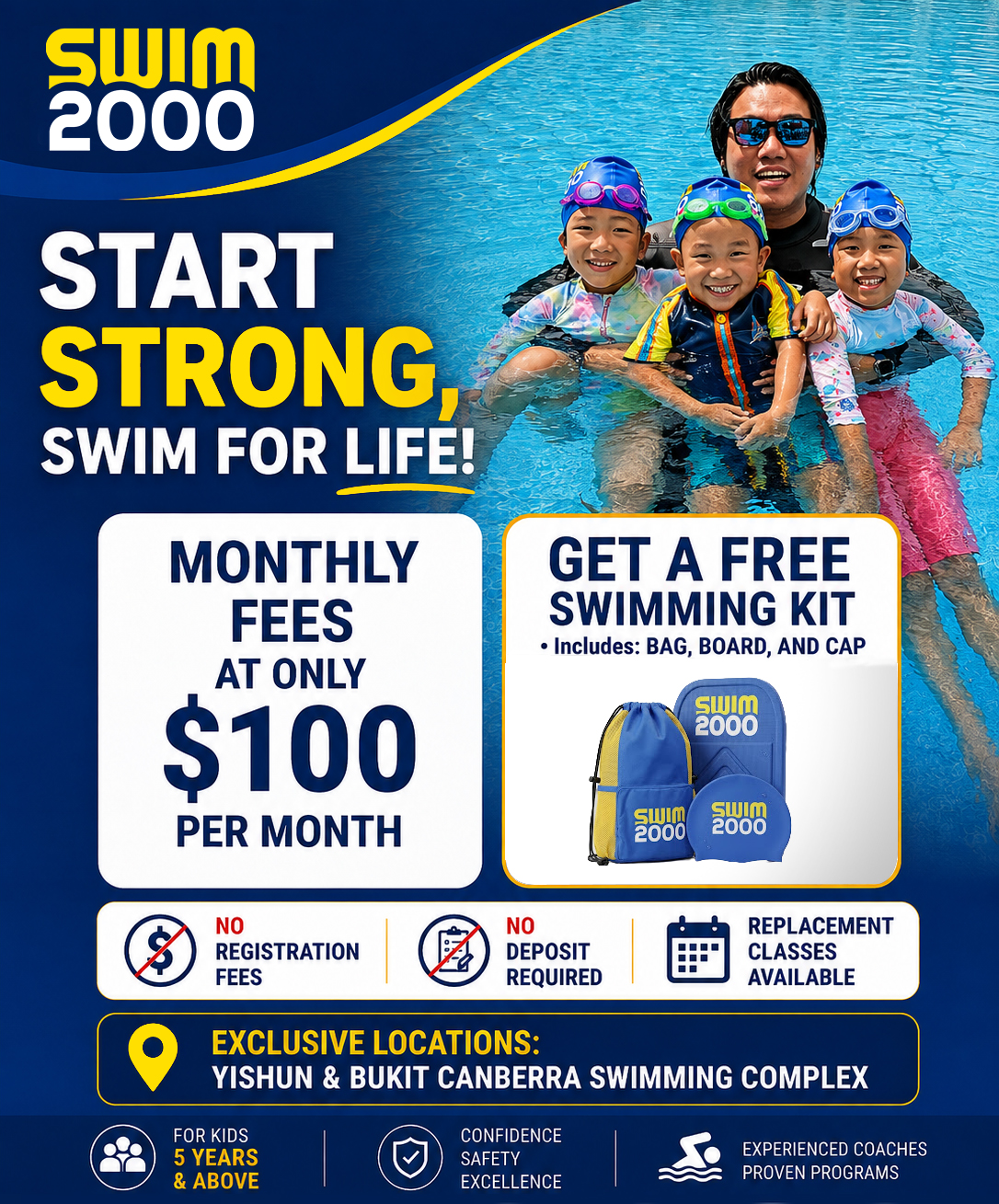
Swimming Lessons in Sembawang: How Parents Can Choose a Nearby Programme

Parents searching for swimming lessons in Sembawang are usually trying to solve two problems at once: finding a suitable programme for their child and finding one close enough to attend consistently. In North Singapore, that often means comparing options around Sembawang, Canberra, Bukit Canberra and Yishun rather than choosing a swim school based only on its name or advertised programme.
For beginners, location matters because swimming is learned through repetition. A programme that fits the family’s weekly routine makes regular attendance easier. But convenience should not replace the more important question: does the lesson match the child’s current ability and next learning objective?
This guide explains how Sembawang families can evaluate nearby swimming lessons, what to look for at different stages, and when SwimSafer or focused stroke work becomes relevant.
Start With Your Child’s Current Swimming Ability
Age is useful context, but it does not determine a child’s swimming level. Two children of the same age can require very different lessons.
A complete beginner may still be learning to put the face in the water, exhale, float and recover to a standing position. Another child may already swim independently but struggle with breathing or stroke coordination. A third may be preparing for a SwimSafer assessment.
Before comparing locations, identify the main skill your child needs next.
Nervous or complete beginners
For a child who is uncomfortable in water, the immediate priority is water confidence and control. Early lessons should create repeated opportunities to enter the water calmly, submerge, breathe out, float and regain a stable position.
Trying to rush directly into full-length swimming can make learning harder. A tense child often lifts the head, holds the breath and uses excessive movement simply to feel safe. Building control first gives later stroke instruction a better foundation.
Children learning basic strokes
Once a child is comfortable in the water, lessons can place more emphasis on propulsion, body position, breathing and coordination. Progress should be judged by increasing control rather than distance alone.
A child who can swim farther with poor technique has improved endurance, but may not have improved the movement pattern that will support efficient swimming later.
Children following SwimSafer
Parents looking for a structured national pathway can consider the SwimSafer programme. The appropriate stage depends on demonstrated competencies rather than how quickly parents want a certificate.
Good preparation develops the underlying swimming, survival and water-safety skills so the child can perform them consistently, not only during a rehearsed assessment.
Where Can Sembawang Families Look for Swimming Lessons?
Sembawang families do not necessarily need a programme carrying “Sembawang” in its name. In practice, nearby North Singapore locations can be more useful if their schedules and programmes fit the swimmer.
Bukit Canberra is a practical option for many families around Sembawang and Canberra. Parents can review SWIM2000’s swimming lessons at Bukit Canberra when comparing nearby programmes.
Yishun may also be workable depending on where the family lives, studies or works. SWIM2000 also provides information on swimming lessons in Yishun.
The correct comparison is therefore not simply “Which pool is nearest?” It is “Which suitable programme can we attend reliably?”
A five-minute difference in travel time matters less if one timing repeatedly clashes with school, work or another child’s activities. Conversely, a technically suitable programme becomes difficult to benefit from when attendance is irregular.
Why Consistency Matters More Than Finding the Perfect Pool
Swimming combines confidence, coordination and motor learning. Skills become more reliable through repeated correct practice.
For beginners, long gaps can make each lesson feel like a restart. A child may spend part of the session regaining comfort with submersion or breathing instead of building on the previous lesson. For developing swimmers, inconsistent attendance can make technical corrections harder to retain.
This does not mean children must train every day. It means the schedule should be realistic enough to maintain.
When comparing swimming lessons near Sembawang, consider travel time, lesson timing, school commitments, family transport and the child’s energy level. The most impressive programme is not automatically the most useful if the family cannot sustain attendance.
What Should Parents Look for in a Kids’ Swimming Programme?
Families can review SWIM2000’s broader kids swimming lessons in Singapore when considering the learning pathway. At the lesson level, several practical signs are more useful than simply counting pool lengths.
Instructions should match the swimmer’s problem
A child struggling with breathing needs a correction related to breathing, head position or timing. A child whose breaststroke kick produces little propulsion needs a different intervention.
Effective instruction identifies what is limiting the swimmer rather than giving every child the same correction.
Skills should become repeatable
Performing a skill once shows that the child can do it. Performing it repeatedly with less prompting shows that learning is becoming established.
Parents can therefore watch for changes such as calmer submersion, more stable body position, cleaner breathing, better coordination or reduced dependence on the coach.
Progression should have a purpose
Drills should connect to a swimming problem. More drills do not automatically mean better coaching.
A useful drill simplifies part of the movement so the swimmer can practise it more accurately before reintegrating it into the full stroke.
How SwimSafer Fits Into the Decision
SwimSafer is important to many Singapore parents because it provides a structured progression in swimming and water-safety competencies. However, choosing lessons solely to pass the next assessment can narrow the focus too much.
Assessment readiness should follow skill readiness.
A swimmer who has strong foundational skills is better positioned to progress through later stages because breathing, balance, propulsion and water confidence support more advanced tasks. A child who is rushed through early skills may encounter the same weaknesses again when distances and coordination demands increase.
Parents should ask what their child is currently learning, which competency is limiting progression and what needs to become consistent before assessment.
For common questions about programmes and lesson arrangements, SWIM2000’s FAQ provides additional information.
When Does a Child Need Stroke Correction Instead?
Not every swimmer needs ordinary beginner lessons indefinitely. Once a child can swim independently, progress may be limited by a specific technical fault.
Examples include a breaststroke kick that pushes water in the wrong direction, freestyle breathing that lifts the head excessively, or body position that creates unnecessary drag.
At that point, simply adding more distance may reinforce the same problem. Focused technical work can be more appropriate.
SWIM2000’s stroke correction clinic is intended for swimmers whose main need is technique improvement rather than basic water confidence. The distinction matters: beginner instruction builds foundational independence, while stroke correction targets an established movement pattern.
Should You Choose a Programme by Coach or Location?
Both matter, but they solve different problems.
Location affects whether the family can attend consistently. Coaching affects what the swimmer learns during those sessions.
A nearby programme with poor fit is not automatically better because it saves travel time. Likewise, a strong programme that requires an unsustainable weekly journey may lead to missed sessions.
Parents should look for a workable combination: a convenient-enough location, an appropriate class level and coaching that provides specific feedback.
Coach Jack Lee is part of the SWIM2000 coaching team. For parents comparing programmes, the useful question is not whether one coaching style looks more demanding from the poolside. It is whether the swimmer receives instruction appropriate to the skill being developed.
A Practical Checklist for Sembawang Parents
Before enrolling, parents can use a short decision framework.
First, identify whether the child is a nervous beginner, an independent beginner, a SwimSafer swimmer or someone needing technical correction.
Second, compare nearby locations based on the real weekly journey rather than map distance alone. Include school dismissal, transport and other family commitments.
Third, check whether the available class matches the swimmer’s ability. Age-based grouping alone may not tell you whether the technical level is suitable.
Fourth, ask what progression looks like. Parents should understand what the child is learning now and what competency comes next.
Finally, consider whether the arrangement can be sustained for months rather than merely fitting one convenient week.
Frequently Asked Questions
Are there swimming lessons near Sembawang?
Yes. Families around Sembawang can compare nearby North Singapore options, including programmes around Bukit Canberra and Yishun. The most suitable choice depends on the child’s level, schedule and the family’s travel routine.
Is Bukit Canberra convenient for Sembawang families?
It can be, particularly for families living or travelling around Sembawang and Canberra. Convenience is individual, so compare the actual lesson timing and journey rather than location names alone.
Should my child start with SwimSafer?
SwimSafer can provide a structured pathway, but the child’s starting skills still matter. A nervous beginner may first need water confidence and basic control before assessment-oriented progression becomes useful.
How do I know if a swimming class is the right level?
The lesson should address the swimmer’s current limiting skills without requiring constant assistance for tasks that are too advanced. Ask the coach what the child is working on and what must improve before progressing.
How often should my child attend swimming lessons?
There is no single frequency that fits every child. Consistency is the key factor. A sustainable regular schedule is generally more useful for motor learning than frequent interruptions and long gaps.
When should my child move to stroke correction?
Consider focused correction when the child already swims independently but an established technique problem is limiting efficiency or progress. If the swimmer still lacks basic water confidence or independent movement, foundational lessons remain more appropriate.
Are private lessons better than group lessons?
Neither format is automatically better. The appropriate choice depends on the child’s learning needs, confidence and the amount of individual feedback required. The class format should allow the swimmer to practise enough while receiving useful corrections.
Choosing Swimming Lessons Near Sembawang
For Sembawang parents, the best nearby swimming programme is not determined by postal code alone. The practical choice combines three factors: a location the family can attend consistently, a class that matches the child’s current ability, and coaching that develops the next required skill.
Bukit Canberra and Yishun can both be relevant options for families in North Singapore. Compare them based on the weekly routine and the swimmer’s learning stage rather than assuming the closest pool must be best.
Once the location works, judge progress in the water. Look for greater confidence, more repeatable skills, improving technique and increasing independence. Those are stronger indicators of a useful swimming programme than distance covered in a single lesson.
Ready to Start Swimming?
Book your first lesson with our certified coaches today. Suitable for all ages and skill levels.
Join Our Class NowTypically replies within minutes · No commitment required