SwimSafer Stage 2 Test: What Your Child Must Be Able to Do
Parents searching for the SwimSafer Stage 2 test often focus on one question: can my child swim 25 metres? That distance matters, but it is only part of the practical assessment.
Sport Singapore’s SwimSafer 2.0 Instructor’s Manual block plan, updated 1 July 2025, lists three Stage 2 assessment components: a 25-metre swim on the front, a 15-metre swim on the back, and Sequence 2A without goggles. Sequence 2A combines entry, floating, short swims, a rollover, stationary-water control, object recovery and a safe exit.
This guide focuses specifically on the Stage 2 test and readiness. For the broader six-stage pathway, parents can review SWIM2000’s SwimSafer programme in Singapore.
What Is Tested in SwimSafer Stage 2?
The Stage 2 practical assessment has three main parts.
First, the child swims 25 metres on the front. The official block plan allows alternating arms and legs or simultaneous arms and legs.
Second, the child swims 15 metres on the back, again using alternating or simultaneous arm-and-leg movement.
Third, the child completes Sequence 2A without goggles. The sequence requires the swimmer to enter with a step-in entry, float on the front for 10 seconds, swim 5 metres on the front, roll over, float on the back for 10 seconds, swim 5 metres on the back, scull, float or tread water for 30 seconds, recover an object in chest-deep water, resurface and exit safely.
These components test different abilities. A child can be strong at forward swimming but uncomfortable on the back. Another may complete both distance swims but struggle to float calmly without goggles.
Readiness therefore needs to be checked across the whole assessment, not only by distance.
The 25m Front Swim
The 25-metre front swim demonstrates that the child can move continuously and independently over a meaningful distance.
Parents sometimes assume that the fastest swimmer is the most assessment-ready. Stage 2 is not a race. A child who starts too quickly, becomes breathless and loses control halfway through may be less prepared than a swimmer who moves steadily from start to finish.
Watch for whether your child can maintain a repeatable movement pattern. Excessive head lifting, repeated stopping or panic around breathing are signs that the distance is not yet comfortable.
If the swimmer reaches 25 metres only occasionally, ask the coach what is limiting consistency. The issue may be breathing, body position, propulsion or confidence.
The 15m Back Swim
The back swim is a separate requirement and should not be treated as an easy extra simply because the distance is shorter.
Some children become tense when water reaches the ears. Others lift the head, bend at the hips or lose direction because they cannot see where they are going.
The goal is controlled movement on the back for 15 metres. Parents should look for a child who can remain reasonably relaxed, continue moving and recover safely at the end.
A swimmer who is confident on the front may still need dedicated back-position practice. Stage 2 deliberately checks more than one orientation in the water.
Sequence 2A: The Exact Order
Sequence 2A is performed without goggles, so the child should be comfortable having water around the face without becoming distressed.
The sequence begins with a step-in entry. The swimmer then performs a 10-second front float before swimming 5 metres on the front.
After that, the child rolls over, performs a 10-second back float, and swims 5 metres on the back.
Next comes 30 seconds of sculling, floating or treading water.
The child then recovers an object in chest-deep water, resurfaces and exits the pool safely.
The order matters because the assessment checks whether the swimmer can connect skills. Performing a good back float during a normal lesson is useful, but the child must also reach that position after entering, floating, swimming and rolling over.
Why the Rollover Can Be Difficult
The rollover can expose weaknesses in balance and confidence.
A child may rotate too quickly and lose body position. Another may hold the breath, become tense and try to stand. Some swimmers can turn successfully in isolation but struggle when the rollover comes immediately after the 5-metre front swim.
A coach can isolate the transition, correct the movement and then reconnect it to the sequence. This is usually more effective than repeating the entire test sequence without fixing the point where control breaks down.
Why the No-Goggles Requirement Matters
Sequence 2A is explicitly listed as being performed without goggles.
Children who wear goggles for every lesson may know the movements but become uncomfortable when water reaches their eyes. They may rush the float, wipe the face, stop during the swim or lose concentration during object recovery.
No-goggles confidence should be built gradually under supervision. Parents should avoid suddenly removing goggles during a difficult full sequence and expecting the child to adapt immediately.
The 30-Second Stationary-Water Component
After the short front and back swims, the child must scull, float or tread water for 30 seconds.
This is different from swimming toward the wall. The swimmer must remain controlled without depending on forward travel to feel safe.
A child who kicks frantically may remain afloat briefly but become exhausted. Better control comes from using a movement the swimmer understands and can sustain.
Parents can ask the coach which option the child is using and whether it remains reliable after the earlier parts of the sequence.
Recovering the Object
The object-recovery component takes place in chest-deep water.
This task combines submersion, orientation and recovery. Some children who are comfortable swimming on the surface become hesitant when asked to go underwater deliberately.
The child should be able to submerge, locate and retrieve the object, return to the surface and continue to the safe exit.
Underwater practice should remain supervised. Parents should not turn object recovery into breath-holding competitions or increasingly difficult underwater challenges.
What About the Stage 2 Survival Skills?
The broader Stage 2 block plan includes survival and activity skills in addition to the assessment sequence. These include sculling, floating or treading water, swimming in swimwear, shorts and a T-shirt, using a survival stroke, fitting an appropriately sized personal flotation device and swimming with it.
Parents should distinguish the programme content from the items shown in the manual’s Stage 2 assessment column. The assessment column lists the 25-metre front swim, 15-metre back swim and Sequence 2A.
This distinction matters because informal summaries can mix teaching outcomes and test components together. If an assessment organiser gives updated instructions, follow the current official requirements for that assessment.
How Can Parents Tell Whether a Child Is Ready?
A useful readiness check is simple: can the child perform every listed component consistently, not just once?
Ask whether the swimmer can complete the 25-metre front swim without stopping. Can the child complete 15 metres on the back without panic or assistance? Can the child hold both 10-second floats? Is the rollover controlled? Can the swimmer manage the 30-second stationary-water task and recover the object without goggles?
The important word is repeatably.
One successful attempt proves that the skill is possible. Repeated successful attempts suggest that the skill has been learned.
Parents should therefore ask the coach about the weakest component rather than only asking, “Is my child ready for the test?”
Common Stage 2 Readiness Problems
The child can swim 25m but stops on the back
This usually means overall distance is not the issue. Back-position confidence or propulsion needs more work.
The child can float but loses control during the rollover
Practise the transition as its own skill before repeating the whole sequence.
The child refuses to perform without goggles
Build no-goggles confidence gradually during easier tasks.
The child rushes the stationary-water section
The swimmer may be using too much effort. The coach can help identify a calmer sculling, floating or treading strategy.
The child avoids object recovery
Work on controlled submersion progressively. Fear should be addressed before adding pressure from an assessment date.
Should Parents Book the Test as Soon as 25m Is Achieved?
Not necessarily.
Swimming 25 metres is an important milestone, but Stage 2 checks a broader set of fundamental water skills. Booking too early can turn lessons into repeated test rehearsals before the child has dependable control.
A better approach is to let assessment follow competence.
Parents can ask the coach to run through the official components and identify anything that remains inconsistent. Once the whole set of skills is stable, the assessment becomes a check of existing ability rather than an attempt to produce a new skill on the day.
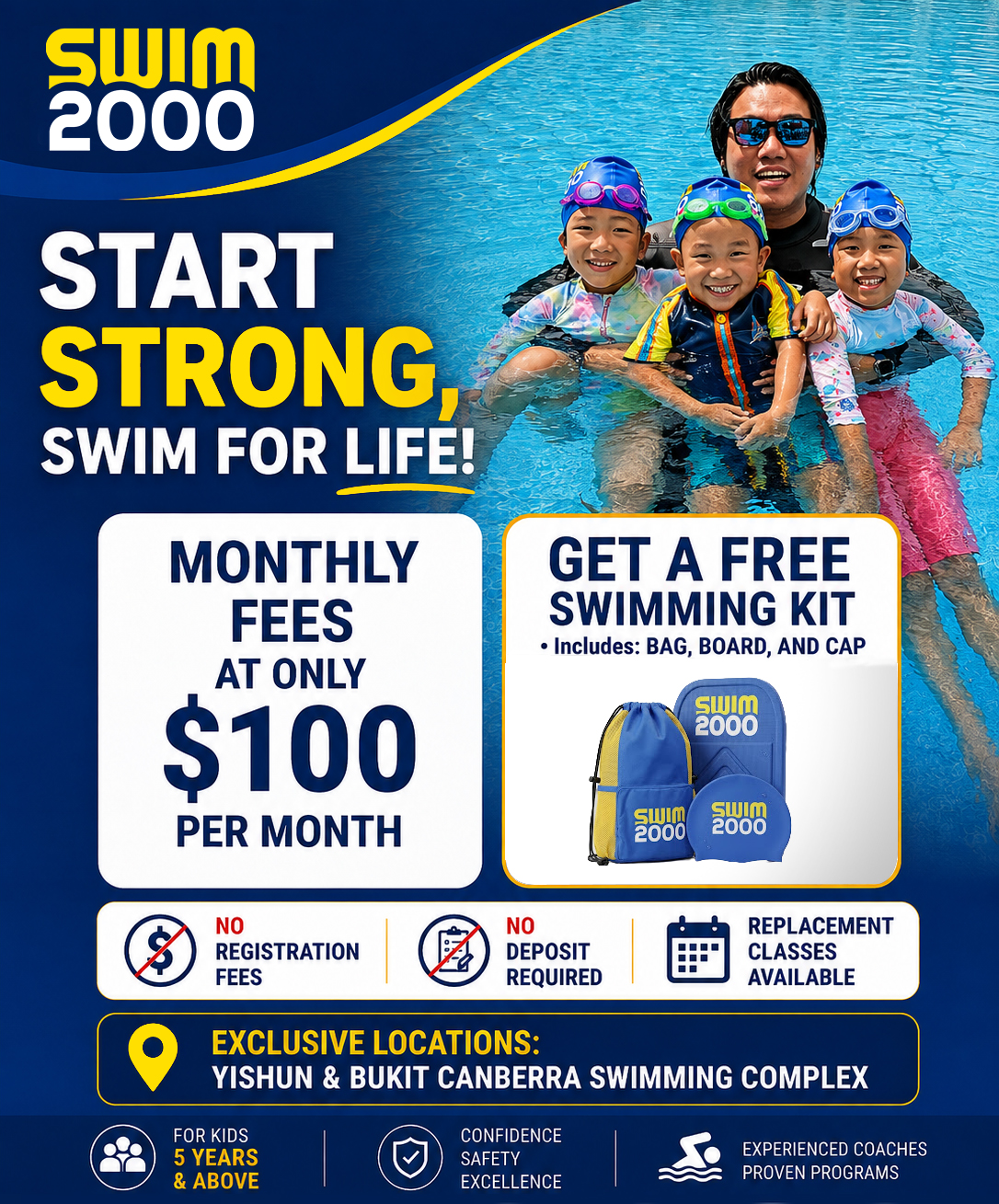
For structured preparation, SWIM2000 offers kids swimming lessons in Singapore as well as swimming lessons in Yishun and Bukit Canberra swimming lessons.
Coach David Lim is part of the SWIM2000 coaching team.
What Happens With the SwimSafer Theory Requirement?
SwimSafer certification includes theory as well as practical assessment.
ActiveSG currently states that private SwimSafer assessments are managed through CAMS, with the applicable online theory quiz completed through that process. Administrative timelines and systems can change, so parents should follow the latest instructions from the assessment organiser.
The practical Stage 2 test and theory requirement are separate preparation tasks. A child can understand water-safety concepts while still needing more time to master a practical skill.
Frequently Asked Questions
How far does a child swim in the SwimSafer Stage 2 test?
The current block plan lists a 25-metre swim on the front and a 15-metre swim on the back.
Is freestyle compulsory for the 25m swim?
The Stage 2 assessment wording allows alternating arms and legs or simultaneous arms and legs. It does not state that competitive front crawl is the only permitted movement.
Are goggles allowed for Sequence 2A?
No. The July 2025 block plan lists Sequence 2A as being performed without goggles.
What does Sequence 2A include?
It includes a step-in entry, 10-second front float, 5m front swim, rollover, 10-second back float, 5m back swim, 30 seconds of sculling, floating or treading water, object recovery, resurfacing and a safe exit.
Does Stage 2 include PFD skills?
PFD work appears in the broader Stage 2 survival and activity skills in the official block plan. However, the Stage 2 assessment column itself lists the two distance swims and Sequence 2A.
What if my child can do every skill separately but not the sequence?
The transitions need practice. Ask the coach to identify where control breaks down and work on that connection before repeating the entire sequence.
How do I know when to register for assessment?
Register when the child can perform the required components consistently and the coach considers the swimmer ready, rather than immediately after one successful 25-metre swim.
Prepare for the Whole Stage 2 Test
The SwimSafer Stage 2 test is a check of fundamental water control, not a single-distance challenge.
A child needs to handle front and back swimming, floating, orientation changes, stationary-water control, underwater object recovery and a safe exit. When these skills are reliable, assessment day becomes much more straightforward.
Focus on the component that is least consistent, let the coach correct it, and allow the certificate to follow the skill rather than the other way around.
Ready to Start Swimming?
Book your first lesson with our certified coaches today. Suitable for all ages and skill levels.
Join Our Class NowTypically replies within minutes · No commitment required